Choosing the right project management methodologies: A practical guide
In this article, we’ll explore seven project management methodologies – Waterfall, Agile, Scrum, Kanban, Lean, Six Sigma, and Critical Path Method (CPM)…
By Grapefruit teamPublished Updated 4 min read

In this article
Let’s make it clear: nowadays, delivering work on time, on budget, and with high impact isn’t optional; it’s the whole point. And at the heart of it all lies your project management methodology. Whether you’re launching a complex platform build or iterating on a content sprint, the approach you choose shapes everything: timelines, team dynamics, client collaboration, and ultimately, the quality of the outcome. So, how do you know which one fits best?
Project management methodologies: Waterfall
For when scope is fixed and change is not your friend
Waterfall is the classic, linear project management methodology: plan, design, build, test, deliver. It works best when you know exactly what needs to be done from the beginning – and nothing will change halfway through (spoiler alert: that rarely happens in digital).
- Best for: Website revamps with fixed requirements and timelines.
- Watch out for: Low adaptability if feedback comes late or requirements shift.
- Agency tip: Useful for projects with heavy documentation or compliance constraints, like banking platforms or government websites.
Project management methodologies: Agile
The go-to for flexibility and iteration
Agile project management is more of a mindset than a method: value collaboration over processes, working software over documentation, and responding to change over following a plan. It breaks work into smaller cycles (sprints) and involves frequent check-ins, allowing for flexibility and fast iteration.
- Best for: Digital products in active development or design systems evolving over time.
- Watch out for: Without discipline, Agile can turn into chaos. You need strong alignment and dedicated roles.
- Agency tip: Clients love visibility and involvement, but prepare them for constant collaboration.
Project management methodologies: Scrum
Agile, but with structure and velocity
Scrum is one of the most popular Agile frameworks. It introduces roles like Scrum Master and Product Owner, works in sprints (typically 2 weeks), and keeps things moving with stand-ups, retrospectives, and sprint planning sessions.
- Best for: Cross-functional teams working on digital platforms or apps where priorities may shift weekly.
- Watch out for: Misunderstanding roles or skipping ceremonies leads to frustration, not faster delivery.
- Agency tip: Great for MVP builds or when working closely with a product owner on the client side.
Project management methodologies: Kanban
Visualizing workflow to increase efficiency
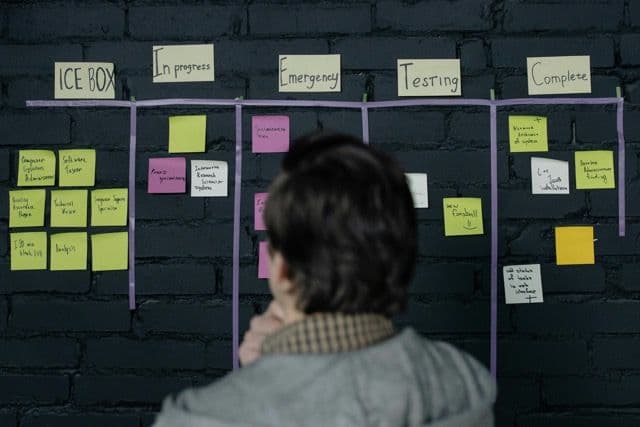
Kanban is all about visualising work in progress and limiting the amount of work done at once. Tasks flow through a board (To Do, In Progress, Done), allowing for quick identification of bottlenecks.
- Best for: Support work, content production, or ongoing tasks with varying priority.
- Watch out for: Without WIP (Work-In-Progress) limits, things can pile up instead of flowing.
- Agency tip: Ideal for content teams, QA tasks, or maintenance work that needs prioritisation, not planning.
Project management methodologies: Critical Path Method (CPM)
When every dependency matters
CPM is a project management methodology that maps out every task, its duration, and dependencies to identify the “critical path” – the longest sequence of dependent tasks that must be completed on time for the whole project to stay on track.
- Best for: Large-scale projects with strict deadlines and complex task dependencies.
- Watch out for: Can be overkill for small or fast-moving teams.
- Agency tip: Useful for multi-vendor projects (like platform migrations) where sequence matters more than speed.
Project management methodologies: Lean
Maximise value, minimise waste
Born in manufacturing, Lean project management focuses on delivering more value with fewer resources by eliminating anything that doesn’t add direct customer value.
- Best for: Streamlining internal workflows, process audits, or improving delivery pipelines.
- Watch out for: Lean thinking requires cultural buy-in. It’s not just “do more with less.”
- Agency tip: Pair it with Agile for an efficiency boost – especially in UX or development phases.
Project management methodologies: Six Sigma
For process excellence and quality control
Six Sigma is a data-driven approach to eliminating defects and improving consistency. It uses methods like DMAIC (Define, Measure, Analyse, Improve, Control) and thrives in process-heavy environments.
- Best for: Agencies dealing with high-stakes deliverables, like pharma or automotive projects.
- Watch out for: It’s complex and often over-engineered for creative teams.
- Agency tip: Use the philosophy, not the full framework, to tighten up QA and hand-off processes.
Which project management methodology should you use?
Here’s the honest answer: this depends on the type of project, your team size, the client’s working style, and your internal maturity level. Got a rigid scope and external pressure? Waterfall. Need speed, iteration, and ongoing feedback? Agile or Scrum. Managing a content factory? Kanban. Coordinating multiple teams with tight dependencies? CPM. Trying to cut the fluff? Lean or Six Sigma can help.
Many agencies blend two or more methodologies to create a hybrid model that fits their reality. For example: Agile core, with Waterfall timelines for stakeholder alignment; Scrum for product dev, Kanban for support teams; Lean processes, but Six Sigma mindset for QA.
Final thoughts on project management methodologies
Choosing the right project management methodology is less about buzzwords and more about strategic fit. It’s about how your team works, what your client expects, and how you define success. After all, project management methodologies are tools. The real magic lies in using them intentionally, adapting when needed, and always keeping your eye on the end goal: delivering impact, not just output.
At Grapefruit, we tailor our approach to each engagement. We’re not married to a single methodology; we’re committed to delivering results, whether that means running a textbook Scrum sprint or visualizing tasks in Kanban to hit campaign deadlines.
Want to see what project management magic looks like?