Search in the AI era (SEO + GEO)
ChatGPT Ads are coming. What does this mean for my brand?
ChatGPT ads are coming. Discover how conversational advertising will reshape intent-based marketing, and what early adopters can gain.
By Grapefruit teamPublished Updated 5 min read
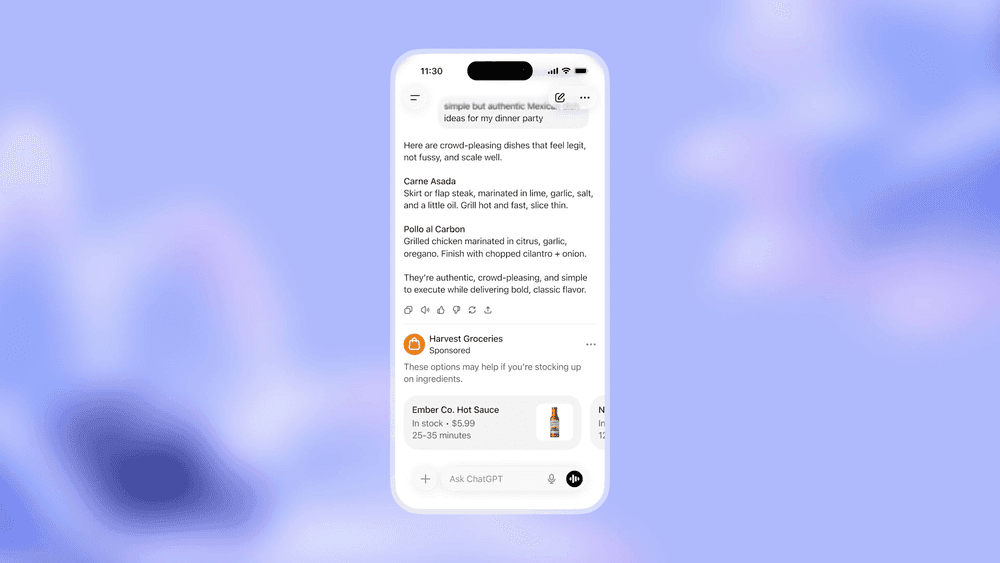
Late last year, OpenAI announced that ChatGPT would launch a paid ads service to marketers, brands, and entrepreneurs to display ads directly in conversation with the AI model. While OpenAI hasn’t yet released many details about how this service would work, they have mentioned that the beta version would be available for a select number of companies as soon as the 6th of February 2026, according to AdWeek.
Nevertheless, marketers see this as the next “gold rush” for early adopters, since it serves over 900 million active users per month, so far.
In this article, we will break down what early rumours mention about the new net platform and how it would benefit both marketers and brands.
OpenAI’s official statement
At the beginning of 2026, OpenAI announced that it would start testing its new platform, ChatGPT ads in the US, with plans to extend to all countries where ChatGPT is present. The ads will run on the free version and ChatGPT Go, the low-tier paid plan, while assuring their users about the continuous value of their services.
The company mentions that conversations will remain private and users’ data will never be sold to advertisers, as the ads are only meant to enhance the conversation experience. The ads will be displayed as relevant to the user inquiry, clearly marked as ads, and will not influence the answers ChatGPT offers.
User trust and experience will remain a benchmark for OpenAI optimization strategies, as the company will not focus on time spent in ChatGPT.
The ads will be displayed when there is a useful product related to the conversation, to help people discover new products and services they would not find otherwise. For brands and small businesses, the ads will be a transformative new tool.
”To start, we plan to test ads at the bottom of answers in ChatGPT when there’s a relevant sponsored product or service based on your current conversation. Ads will be clearly labeled and separated from the organic answer.”
A gold rush for early adopters
Why are marketers so excited about the news of ChatGPT ads? With a market potential of 1 billion dollars in ad revenue for the first year, companies have a unique "once-in-a-decade" opportunity to establish a presence before the platform becomes saturated. Here are the three primary ways early movers can capitalize:
1. Intent-Based Arbitrage
Unlike traditional search engines that rely on static keywords, ChatGPT advertising is driven by real-time conversational intent. This creates a massive performance advantage: early data indicates that users discovering brands through ChatGPT convert at rates 10 to 13 times higher than those coming from traditional search. Companies that move early can benefit from lower initial ad costs (arbitrage) while reaching a highly qualified audience that has already "self-qualified" through their specific conversational prompts.
2. Solving Prompt Gaps with "Micro-Apps"
A sophisticated strategy involves using Answer Engine Optimization (AEO) tools to identify where ChatGPT currently fails to provide high-quality answers. Companies can build specialized, "vibe-coded" micro-apps or desktop tools designed to solve these specific user problems. By running ads for these tools directly against the relevant prompts, brands can offer a superior, interactive solution that far exceeds a simple text response, capturing the user at the exact moment of need.
3. The "Citation Play" (Modern AdSense)
ChatGPT generates answers by looking for trusted sources across the internet, such as niche blogs, Reddit, and review sites. Companies can capitalize on this by creating or partnering with niche ranking and review websites. By ensuring their brand is frequently "cited" across these reputable third-party sites, they increase the likelihood that the AI will recommend them as the definitive "best" answer. This "paid citation" model is expected to be more effective and harder for AI engines to penalize than traditional link-building.
Rumored Functions, Pricing, and User Experience
OpenAI is expected to prioritize a seamless user experience to avoid alienating its core user base, leading to several rumored specifications for the upcoming ad product:
- Contextual Integration: Ads are expected to be highly contextual and native to the conversation, potentially allowing users to complete transactions directly within the chat interface.
- Transaction-Based Pricing: While traditional ads use auction models, rumors suggest OpenAI may explore a model where they take a percentage of the transaction facilitated by the ad.
- Advanced Analytics: A significant addition will be a dedicated analytics suite, finally allowing marketers to see exactly how their brand is being cited by the AI and which topics are driving the most visibility.
- Gradual Rollout: To maintain user trust, the integration of ads is expected to be extremely gradual, focusing on adding long-term value rather than simple interruption.
Conclusion: Seizing the Conversational Frontier
The shift toward ChatGPT ads represents moving from a world of passive scrolling and keyword matching to one of active dialogue and real-time intent capture. For marketers, the "gold rush" window is open now, offering a rare opportunity to secure high-intent audiences at lower initial costs before the platform reaches peak saturation.
As we look toward 2026, the brands that thrive will be those that prioritize contextual relevance and provide genuine value within the conversational flow. This is a new playbook where authenticity and problem-solving outperform traditional, sales-heavy messaging.
At Grapefruit, we are already at the forefront of this AI discovery revolution. With over 26 years of digital innovation, we help brands navigate these complexities through specialized services such as AI Strategy and AI Enhanced Marketing Campaigns. Whether you are looking to optimize your brand for AI-native discovery or build custom, interactive micro-tools to capture user intent, we provide the strategic heart and technical expertise.
The conversation is already happening. Is your brand part of the answer?